

Monthly
Newsletter

Establish a Tax-Smart Giving Tradition

DAFs and the OBBBA

For many families, this time of year is a chance to reflect on values. The recent government shutdown and its ripple effects—furloughs, delayed paychecks and withheld SNAP benefits—prompted a wave of generosity. People are also stepping up donations of cash, appreciated assets, food and other essentials during these times of need. It’s a reminder that charitable giving isn’t just a financial strategy—it’s a way to model compassion and community involvement.

As the days grow shorter and we prepare for 2026, there’s a timely opportunity to help your charitable giving go further before 2025 is over. You may be able to support the causes you care about and boost your bottom line.

Giving as a Family Value

A powerful way to build a legacy of generosity is by enabling younger family members to take an active part in your giving. If you have a donor-advised fund (DAF—learn more here), consider allowing a child or grandchild to recommend a grant to a charity or cause that resonates with them. It’s a simple gesture that can spark meaningful conversations about values, community and impact.

If you need help finding an organization to give to, CharityNavigator.org is a handy resource. It allows you to search and compare nonprofits based on transparency, financial health and effectiveness—making it easier to choose organizations that align with your family’s values.

Whether you’re supporting food banks, disaster relief, education or the arts, giving together can be a way to connect across generations and make philanthropy a shared tradition.

Now, let’s review what makes these last few weeks of 2025 a good time to consider establishing that tradition.

Tax Laws Are Changing in 2026

Under the new One Big Beautiful Bill Act, charitable deductions will face limitations next year and beyond. Senior Director of Family Office Financial Planning Frank Sennott has his eyes on three key areas that could affect client giving strategies:

  1. A new floor for deductions. Beginning in 2026, charitable gifts can only be claimed as itemized tax deductions to the extent they exceed 0.5% of your adjusted gross income (AGI). For example, if your AGI is $1 million, the first $5,000 of giving won’t count toward your itemized deductions.
  2. Standard deduction vs. itemizing. If you take the standard deduction—which for married couples is currently $31,500—you’ll need to give more than the difference between your capped state and local tax (SALT) deduction and the standard deduction to see any tax benefit. Without a mortgage interest deduction, that gap could be $20,000 or more before charitable gifts begin to lower your taxes.
  3. A cap on deduction value. Even when your gifts qualify, the tax benefit of your itemized deductions will be capped at 35 cents on the dollar. That’s below the current top federal marginal rate of 37%, meaning high earners will see less of a tax benefit from each dollar donated starting next year.

Why 2025 Is the Year To Act

These changes make the timing of gifts important if you also want to save on taxes and maximize the impact of your giving. For many high earners, 2025 presents a window to “load up” a donor-advised fund and lock in today’s more favorable deduction rules.

Here’s how that could work:

  • Frontload your giving. By contributing several years’ worth of donations (“bunching”) to a DAF in 2025, you can secure the current higher deduction rates and avoid the new 0.5% AGI floor. You’ll still be able to recommend grants to your favorite charities over time, just as if you were making annual gifts. For example, say you bunch five years’ worth of giving this year and can afford to make a $250,000 donation to a DAF. At current rates, that could result in approximately $115,000 in combined federal tax savings.
  • Maximize tax efficiency. Consider using appreciated stock or ETFs to fund your DAF. This strategy allows you to deduct the full fair-market value of the assets while avoiding capital gains taxes—making your giving even more efficient.
  • Leverage qualified charitable distributions (QCDs). If you’re age 70½ or older, QCDs from your IRA can satisfy required minimum distributions and provide a direct charitable benefit without itemizing your taxes. This will potentially be more valuable as itemized deductions face new limits starting in 2026.

Planning Ahead

The new rules don’t eliminate the benefits of charitable giving, but they do shift the landscape. For high-income donors, especially those who itemize, the difference between giving in 2026 versus 2025 could mean tens of thousands of dollars in lost deductions.

If you’re considering a significant gift—or even just want to make sure your regular giving continues to be tax-smart—now is the time to talk strategy. We’re here to help you think through the options, run the numbers, and make sure your generosity continues to benefit both your causes and your financial plan.

Let’s make 2025 a year of meaningful impact.

Our Latest Podcast Episodes

Episode two of The Human Side of Wealth podcast, “What the New Tax Law Means for You,” features host Andrew Busa, director of financial planning, and Chris Hernandez, tax associate. The pair breaks down the One Big Beautiful Bill Act to share what will matter most for individuals and families. President of Private Wealth Steve Reder joins in to discuss how our advisory team is working with clients to navigate the new landscape. Listen now!

In “Charitable Giving Strategies That Go Beyond the Numbers,” Andrew is joined by Steve Reder and Nicole LaChapelle, president of Family Office, to unpack the art and science of charitable giving. Listen here!

When Diversification Gives Back

Global Investing

After more than a decade of U.S. market dominance, 2025 is proving to be a different kind of year. While the S&P 500 has delivered solid price returns of around 13% year to date, international stocks have surged ahead, with gains exceeding 26%. For investors who maintained globally diversified portfolios through the long stretch of U.S. outperformance, this year serves as a timely reminder of why we stay committed to diversification—even when it’s uncomfortable.

The Test of Discipline

From 2010 through 2024, U.S. stocks delivered total returns exceeding 600% compared with less than 100% for international markets. Year after year, investors wondered: “Why do we still own international stocks when U.S. markets keep winning?”

It’s a fair question. Watching one part of your portfolio consistently lag the other requires conviction. Some investors abandoned international exposure entirely, betting that U.S. tech giants would continue their dominance indefinitely. The temptation to chase recent winners is always powerful.

But as wealth managers, we know that market cycles don’t last forever. History shows us that leadership rotates between regions—U.S. stocks led in the 1990s and 2010s, while international markets had their turn in the 1980s and 2000s. More recently, foreign stocks outperformed U.S. markets in 2017 and 2022. Our job is to position portfolios for the full cycle, not just the most recent chapter.

When the Cycle Turns

This April brought a stark illustration of why diversification matters. When President Trump announced sweeping tariffs on April 2—what he called “Liberation Day”—U.S. markets reacted sharply. The S&P 500 dropped 15% from its peak, with the decline happening in just days.

International markets, while not immune to the shock, proved more resilient. They experienced less volatility and recovered faster. Though U.S. markets rebounded to reach new highs by late June (and have since made new records), the turbulence demonstrated the real-world value of geographic diversification. This wasn’t luck—it was the natural result of different markets having different exposures to U.S. policy uncertainty.
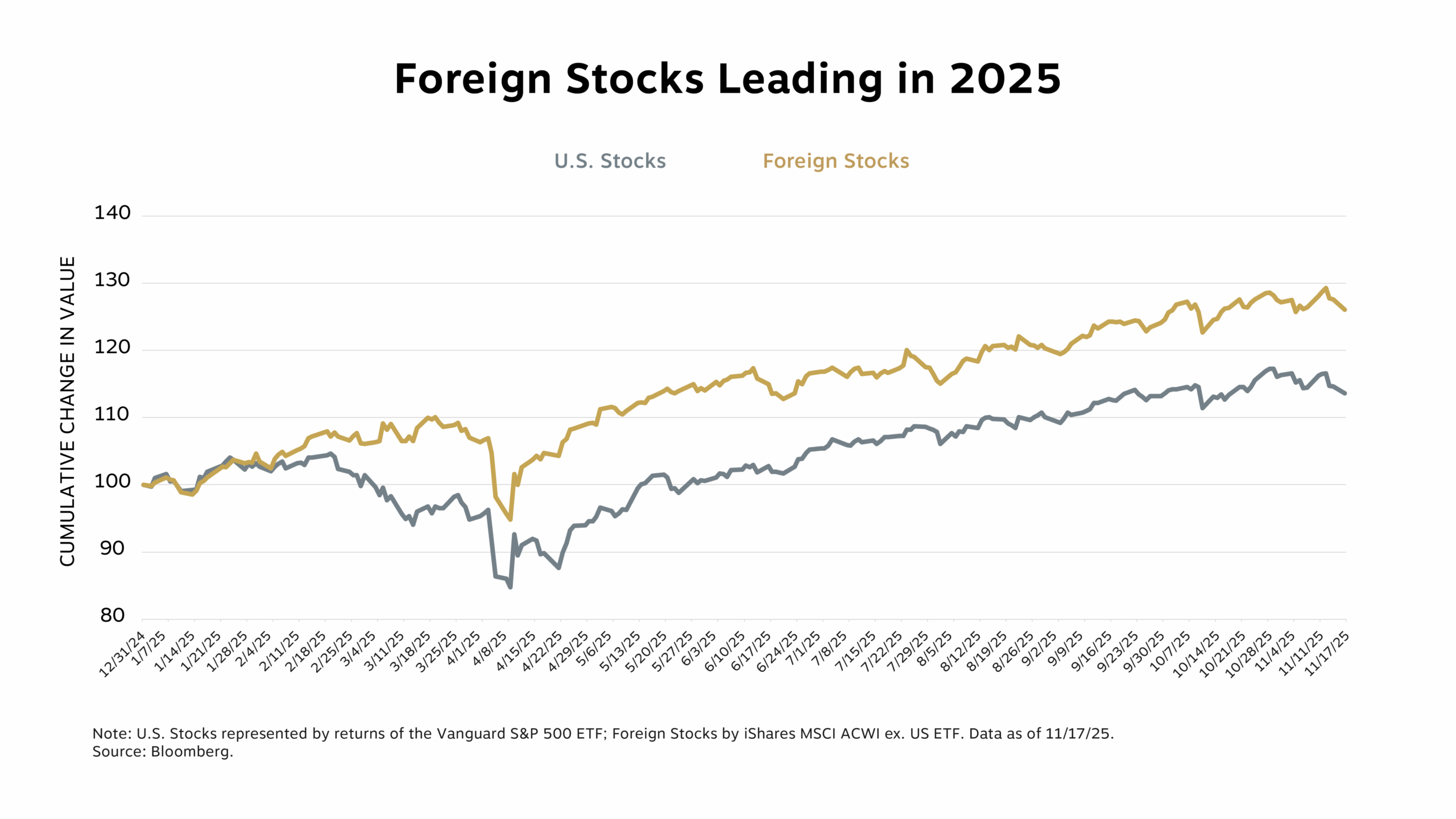

By maintaining international exposure, diversified portfolios absorbed the turbulence better. They also participated fully in the international surge that followed, as global investors reconsidered their heavy U.S. concentration.

Today’s Opportunity

International markets aren’t just rewarding past patience—they’re presenting compelling opportunities going forward.

The valuation gap has widened dramatically. International stocks trade at roughly 13 to 14 times forward earnings compared with 21 times for the S&P 500. That represents about a 35% discount for similar-quality companies, simply based on where they’re headquartered.

Concentration is another factor. The five largest U.S. companies—Apple, Microsoft, Nvidia, Amazon and Alphabet—now represent more than a quarter of the S&P 500’s value. In international markets, the top five holdings account for just 7% of the index. This diversification within diversification provides additional portfolio resilience.

The weakening dollar has amplified international returns for U.S. investors. When foreign currencies strengthen against the dollar, as they have this year with an 8% decline in the dollar index, international investments are worth more when converted back to dollars.

Our Commitment to Diversification

As your wealth managers, we embrace diversification because we’re focused on the long term. We aim to be nimble in adjusting to changing conditions, but not reactionary to short-term performance.

Would it have been easier to abandon international stocks after years of underperformance? Certainly. Would it have felt satisfying in 2023 when U.S. tech stocks soared? Absolutely.

But market timing—whether between asset classes or geographic regions—has proved to be a losing strategy over time. The best performers often come from unexpected places at unexpected times. By the time outperformance becomes obvious to everyone, much of the opportunity has already passed.

The Season of Giving Back

This November, as we reflect on giving back, international stocks are doing exactly that for investors who stayed diversified. The patience required to maintain global exposure through the U.S. winning streak is now being rewarded with stronger returns and smoother volatility.

More importantly, this moment reinforces a fundamental principle: Diversification works not because every holding wins every year, but because different investments take turns leading. We recommend holding foreign stocks in portfolios precisely for years like 2025.

Market cycles will continue to rotate. U.S. stocks will have their time to lead again. But trying to predict and trade these cycles is far riskier than simply maintaining balanced exposure and letting global opportunities unfold as they will.

That’s the real goal of diversification—not perfect timing, but consistent participation wherever growth happens to emerge within your portfolio.

The Divided Consumer: What a Two-Tier Economy Means for Your Portfolio

Economic Indicators

A significant shift is reshaping the American economy, one that helps explain some of the conflicting signals you may be hearing. While overall consumer spending numbers look resilient, beneath the surface lies a divided reality that’s influencing the investment landscape.

The Growing Divide

By the second quarter of 2025, the top 10% of earners accounted for 49.2% of all consumer spending—the highest level since recordkeeping began in 1989. High-income households continue spending at strong levels, supported by solid wage growth, healthy savings and years of investment gains. Meanwhile, lower- and middle-income households face a different reality: Their wage growth has slowed to just 1.3% annually and savings rates dropped from 5.7% in April to 4.6% in August as families tapped their reserves to maintain spending.

This matters because different parts of the economy are now moving in opposite directions at the same time.

The Tariff Effect

The 2025 tariff changes have intensified this divide in ways that will likely persist. With U.S. effective tariff rates reaching 18%—the highest since 1934—consumers are bearing 50% to 70% of these costs through higher prices on furniture, electronics, appliances and other goods. These tariffs hit lower-income households harder since they spend more of their budgets on physical goods rather than services.

This creates winners and losers among companies. Businesses serving premium customers can more easily raise prices to cover tariff costs while maintaining their profit margins. Companies dependent on middle-income consumers face pressure from both higher costs and customers who are pulling back on spending—a difficult combination for earnings.

We should note that the Supreme Court is currently deliberating the legality of some of the Trump administration’s tariffs. If these tariffs are struck down, it could provide some consumer relief if companies choose to lower prices in response. It could also provide stimulus to the economy, as the government would likely be on the hook to refund tariffs levied back to the companies that paid them.

What This Means for Markets

When nearly half of all spending comes from the top 10% of earners, businesses serving this group are in a structurally better position. Luxury goods, premium services, high-end travel and upscale dining aren’t just doing well—their customer base continues expanding its spending. Companies serving mass-market consumers face ongoing challenges from both higher costs and customers pulling back.

The dynamics at play also create uneven risks. When lower-income households run through savings and face potential job market weakness, their spending can drop quickly rather than gradually. Credit card debt has returned to pre-pandemic levels while income growth lags, setting up conditions for sudden shifts and increased volatility in consumer sectors.

The Federal Reserve’s Challenge

The divided consumer complicates things for the Federal Reserve. Inflation persists in services and high-end goods driven by affluent demand, while weakness shows up in mass-market segments. This makes interest-rate decisions increasingly difficult and affects how both bond and stock markets respond to Fed policy.

Moving Forward

American consumer demand isn’t weakening uniformly. The segments serving affluent consumers remain strong, and these businesses represent significant portions of major indexes. The challenge for portfolio managers is to understand which companies benefit from concentrated spending power and which are dependent on broad-based consumer strength, then allocate accordingly. In an economy where spending power has become increasingly concentrated, this distinction matters more than it has in years.

Our investment team is watching this trend with interest and will adjust client portfolios as appropriate in response.

The information set forth in this communication is presented by RWA Wealth Partners, LLC (“RWA”). The contents are for informational and educational purposes only and are not intended as investment, legal or tax advice. Please consult with your investment, legal or tax advisor concerning any specific questions you may have. Past results are not indicative of future performance. The historical return of markets generally and of individual asset classes or individual securities may not be an accurate predictor of future returns of those markets, asset classes or individual securities. RWA does not guarantee the accuracy and completeness of any sourced data in this communication.

Never miss an issue.

By providing your email address you consent to receive marketing content from RWA Wealth Partners, LLC.