

Monthly
Newsletter

Are Markets Hunting Ghosts?

Q4 Outlook

Stocks often benefit from a seasonal tailwind in the fourth quarter—will that be the case this year or will investors end up chasing phantoms?

The AI and mega-cap stock story has dominated the narrative for investors once again this year. Narrow participation and high valuations for these stocks could be a liability if earnings results disappoint. We also continue to deal with policy uncertainty out of Washington and geopolitical tensions abroad, though the ceasefire between Israel and Palestine was welcome news.

On the positive side of the ledger, markets are pricing in multiple Federal Reserve rate cuts, which provides some support to stocks and other riskier assets. We’ve also seen continued economic growth and inflation that’s meandering around 3.0% (still above target), which could help both stocks and bonds. Returns have broadened to include more participation from small caps, but big tech and communications stocks are the undisputed leaders this year once again. As we explore below, foreign stocks have been a positive for diversified investors and are on track to outperform U.S. stocks in a calendar year for the first time since 2022 (when they declined less—2017 was the last year in which foreign stocks outperformed U.S. stocks to the upside).

The absence of timely economic data due to the government shutdown could be problematic if it’s sustained, but time and again, investors have shrugged off negativity and driven markets higher. And the economic impacts of shutdowns are typically quickly recovered once the government reopens.

We’re here to manage through distractions, uncertainty and anxiety and make sure that specters conjured by headlines or the latest outrage do not chase you off course. For now, we see opportunities to take advantage of market strength by rebalancing and refilling your liquidity coffers, and we’re looking ahead to furthering your goals in 2026 and beyond.

Markets Recap

The S&P 500 has extended this year’s gains despite some bumpiness earlier this month when President Trump floated a renewed tariff fight with China. As with other tariff threats and posturing, the impact on markets quickly passed, and they resumed their climb higher.
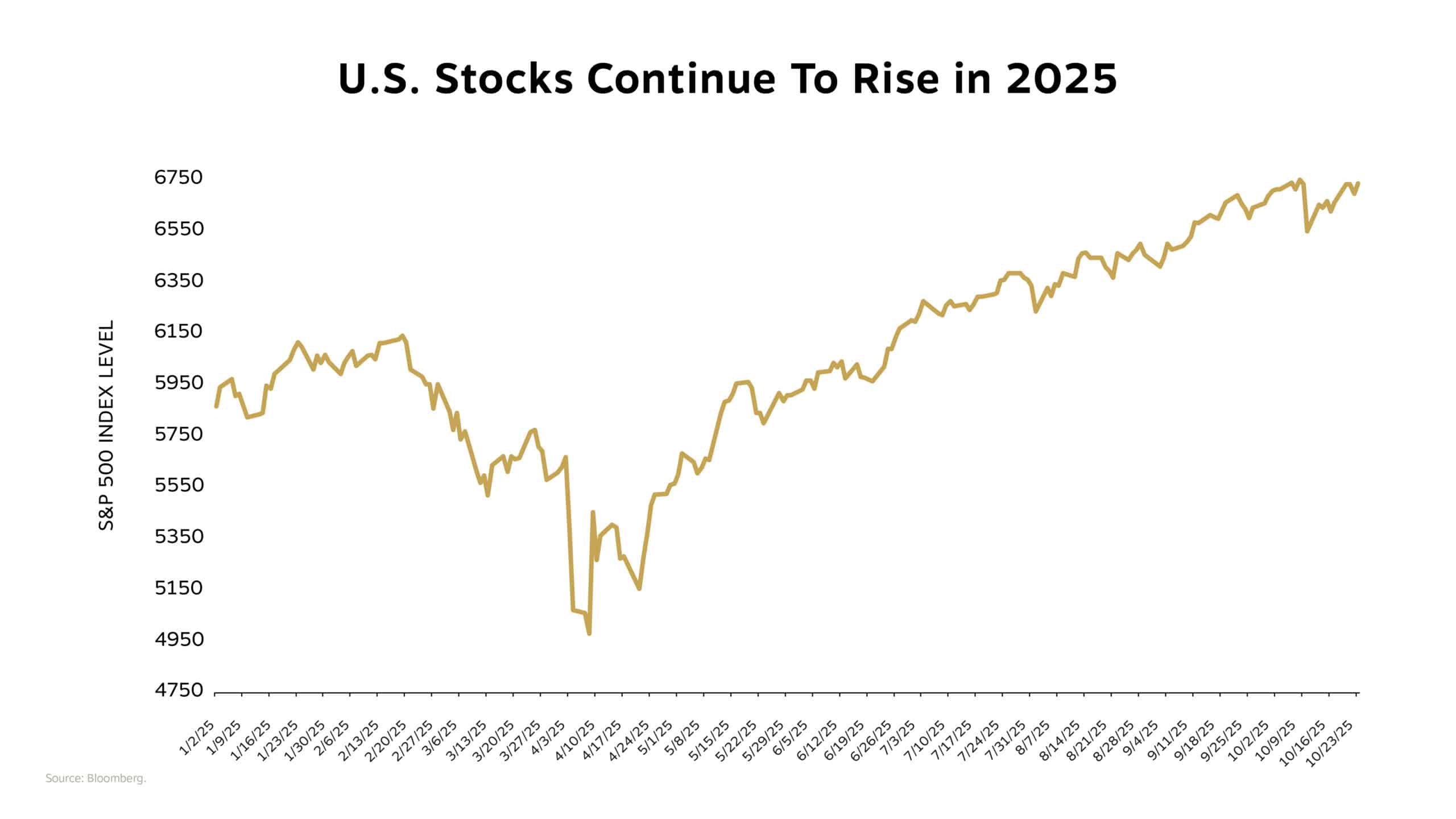
Since the government shutdown has delayed the release of key economic data that would typically be impacting markets, earnings season has taken center stage as we look ahead—and so far, results have been surprisingly strong.

While it’s still early, with only about a quarter of companies in the S&P 500 reporting, sales growth is running at almost 8% and earnings are up over 15%.

And at the sector level, technology, industrial and financial stocks have delivered some particularly bright results, with strong margins and better-than-expected guidance. Utilities have also shown significant earnings growth, and we’ll get into the why momentarily. But outside those sectors, performance has been more mixed.
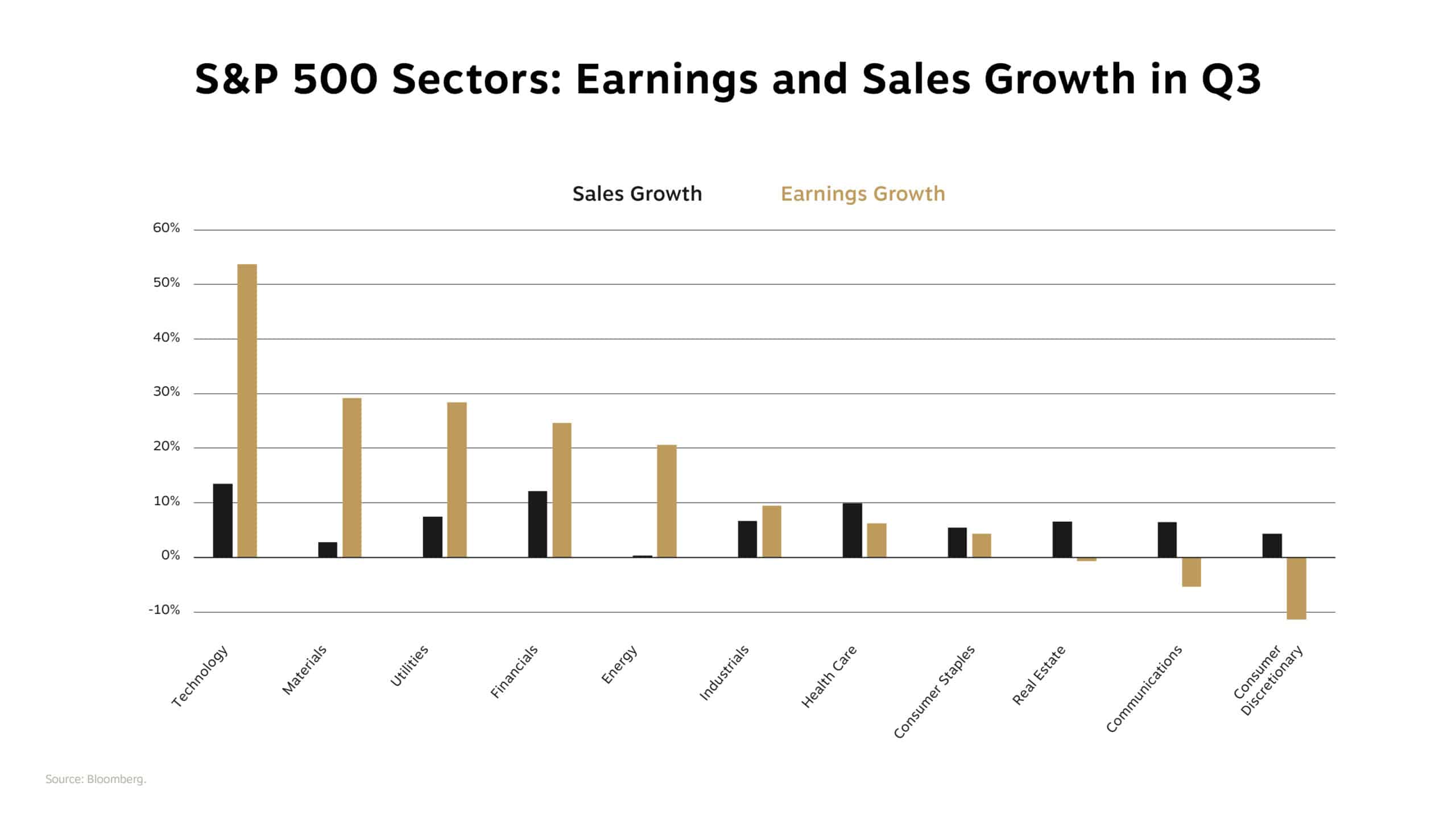
Communications and consumer discretionary sectors have shown strength recently, but there are signs of pressure from rising costs and some slowing demand. It’s still early in the earnings season, and key companies like Meta, Google and Nvidia are among the major names whose results will likely influence market direction.

The Fed, Rates, Gold and Global Leadership

The Federal Reserve met this week, and as we’ve written before, the central bank faces a delicate balancing act. Progress lowering inflation has slowed, fiscal deficits remain large and political pressure on rate policy is mounting.

With all that, as expected, the Fed cut rates by another 25 basis points, despite equity markets making new highs. While the Fed didn’t want to wait for an economic slowdown to start cutting rates, this highlights the clear mismatch between returns in the market and what the Fed is seeing in its economic outlook.

Still, it’s worth pointing out that, alongside the U.K., we have the highest level of rates of the major central banks, so there is room to cut and find an equilibrium rate probably somewhere in the mid to high 3% range early next year. From there, the Fed can be more data dependent—assuming the government is open and releasing economic data by then.

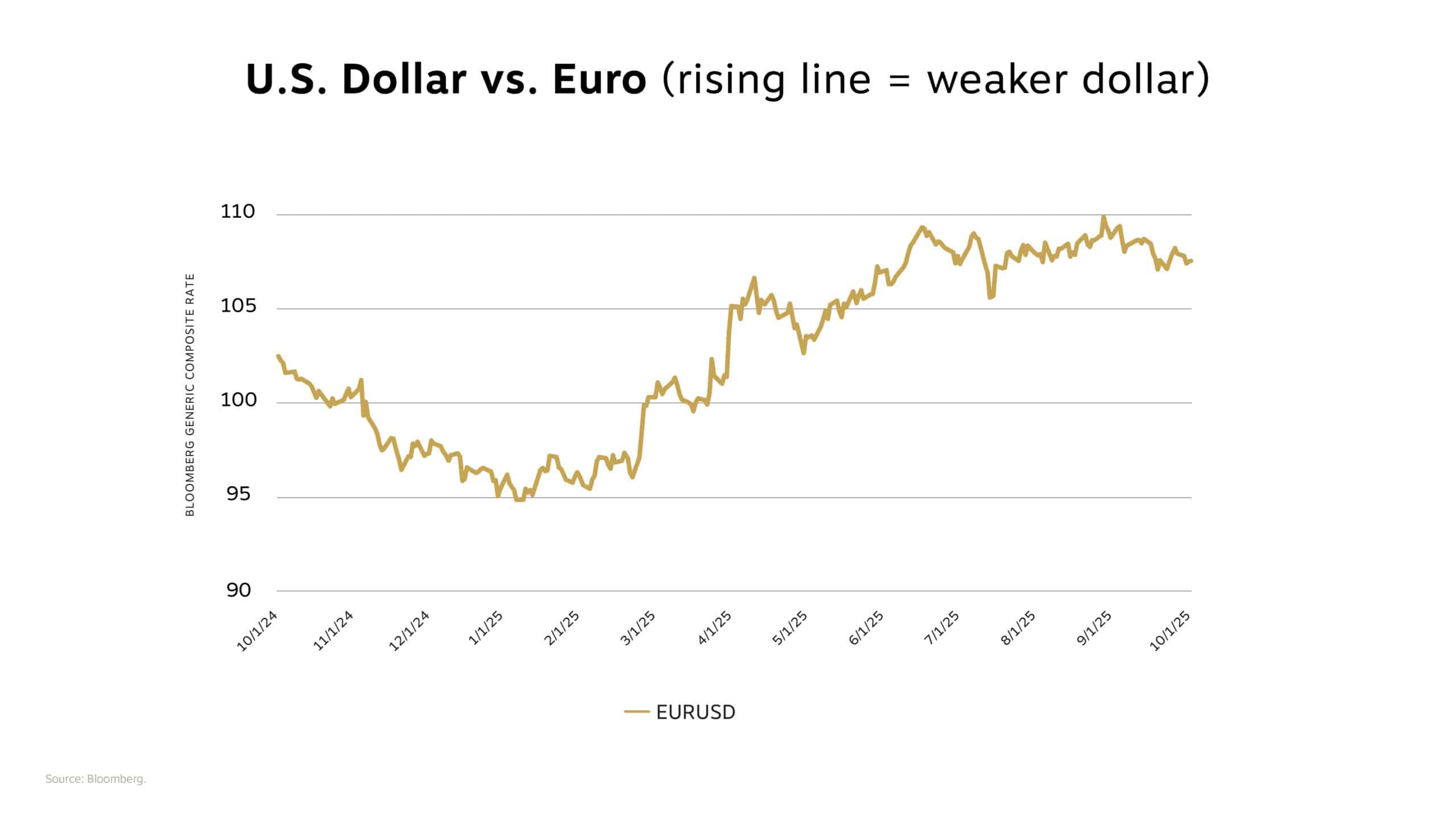
So, with interest rates on the decline, the national debt expanding, and both trade and immigration policies in flux, you can see why the dollar has been under downward pressure this year—highlighted by a comparison of the dollar against the euro over the last 12 months.

These factors have not just impacted the value of the dollar but have contributed to assets like gold surging to all-time highs. Several dynamics are at play, including central banks buying gold as they look to diversify away from the dollar, but much of this development stems from retail investors piling in through ETFs.
But the bigger story may be overseas. The perception of waning U.S. leadership has triggered a significant rally in foreign equity markets. While the S&P 500 is up about 14% this year, countries like Germany are up nearly 40%, China is up roughly 30% and the seldom quoted IBEX 35 index, which represents Spain’s largest stocks, is up over 50%.

Cheaper valuations, earlier rate cuts abroad and currency strength have made 2025 one of the strongest years for international outperformance in over a decade. When confidence in the dollar softens, global capital tends to rotate—and we’re seeing that shift play out in real time.

The AI Energy Story

As more users begin to incorporate AI tools into their work and home lives on a regular basis, the data centers powering the models behind these tools are consuming increasingly large amounts of electricity. According to recent projections, global power demand from data centers is expected to double in the next few years.

Utility companies are scrambling to meet that demand, and you may have noticed a shift in your own energy bills as a result. The price of residential electricity has been on the rise the last few years as the cost of meeting data centers’ electricity use gets passed on to consumers.
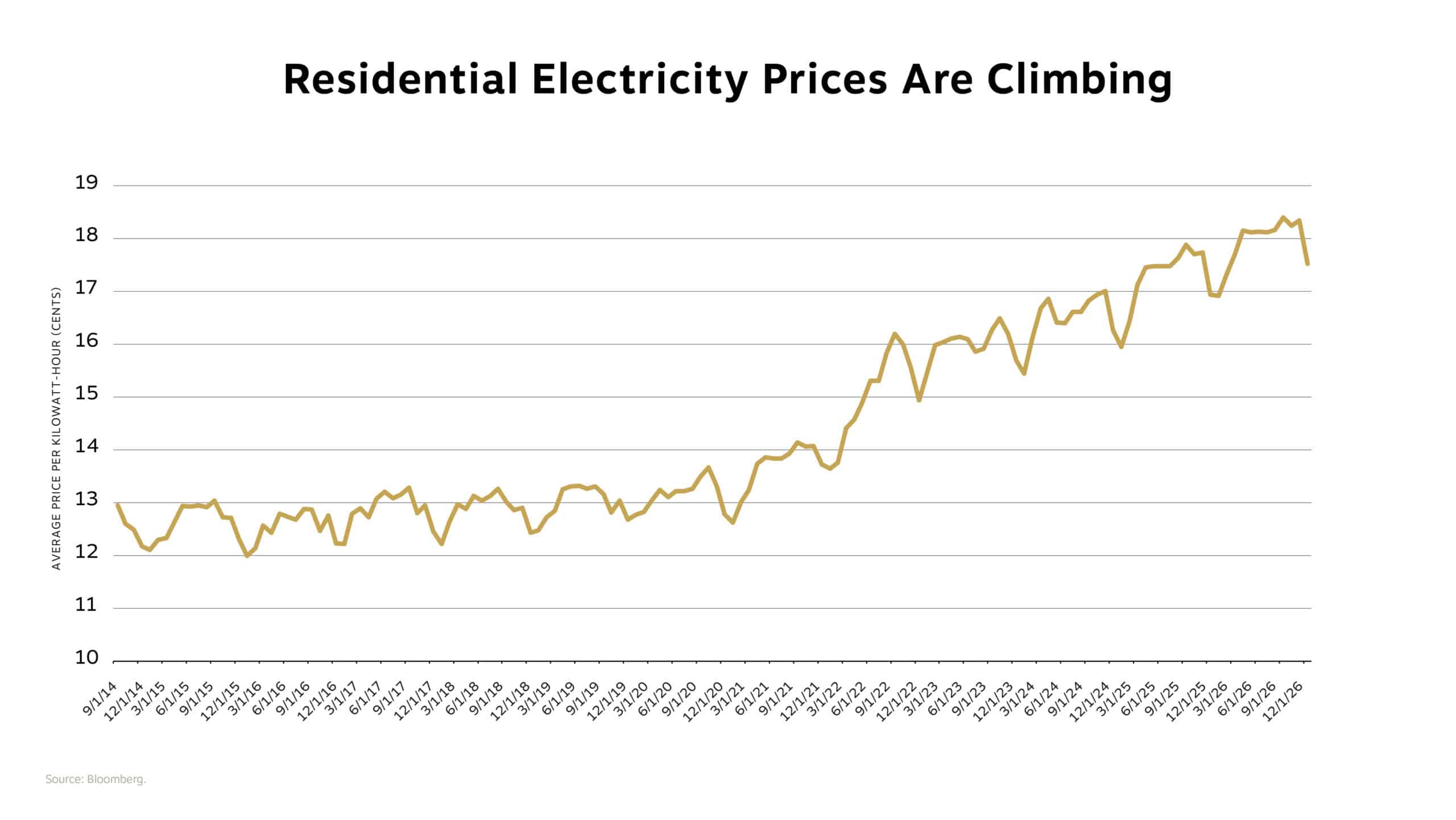
So, while oil and gas prices have eased, the savings at the pump have been offset by an increase in your electric bill. And it’s not likely to slow any time soon as the demand for electricity continues to ramp up.

From an investment standpoint, when we think about the opportunities that this could create, we look beyond traditional energy or commodity investments. The benchmark Goldman Sachs Commodity Index (GSCI) has had an up-and-down run but has done little for investors seeking to track its performance. That’s because the bulk of the index is tied to oil and not to electricity generation.

The price of West Texas crude oil has actually come down materially over the last year as demand for other sources of energy has picked up. This surge in electricity demand is reviving interest in nuclear power. And uranium prices have caught the attention of investors.

The winners are at the company level instead of in the commodities or utilities themselves. Companies like Oklo, a nuclear power operator, and Cameco, which makes uranium, have seen their stocks appreciate rapidly in this environment—far outpacing the results of the commodities in this space.

For energy investors across the globe, this marks a shift—from oil barrels to electrons—as AI reshapes not just productivity but power consumption itself.

Looking Ahead

So, where does all that leave us? Economic and consumer resilience continues to win over the equity markets, gold’s rally signals waning confidence in the dollar and perhaps the U.S. as a whole, and international markets are taking leadership for the first time in years. And while AI is transforming technology, it’s also rewriting the global energy story.

While we do not believe markets are hunting ghosts—they’re instead on the trail of real economic and equity phenomena—we’re aware of just how thin the line can be between sentiment and facts that move markets. Our investment team, portfolio managers, financial planners and tax professionals are continually monitoring for areas of risk and opportunity for your portfolio and wealth plan. Meanwhile, our advisors, client officers and client service team members are working hard to hold monsters real and imagined at bay to help safeguard your accounts. Happy Halloween!

Our Latest Videos, Media Mentions & Our New Podcast

Chief Investment Officer Joseph “JP” Powers discusses the themes we’re tracking as the fourth quarter progresses. Click here to watch now!

Associate Portfolio Manager Josh Jurbala reviews how private equity, private credit and real assets can broaden investment opportunities beyond the public markets. Watch now.

Head of Family Office Fiduciary Services Jacqueline Rahn shares what to consider when choosing a trustee and why selecting the right person can make all the difference. Watch now.

This month, we’re thrilled to launch The Human Side of Wealth Podcast. In our debut episode, Andrew Busa, director of financial planning, and Steve Reder, president of Private Wealth, dive into the emotional side of money. From childhood memories to legacy planning, they share real client stories and personal reflections that reveal how financial decisions are deeply tied to values and relationships. Listen now!

RWA was honored to earn the #20 spot on Forbes’ Top RIA Firms list for 2025. This list ranks 250 independent advisory firms by qualitative and quantitative data, including revenue trends, assets under management, compliance records and industry experience.

The Forbes 2025 Top RIA Firms list includes 250 independent advisory firms with cumulative assets of more than $1.9 trillion. The ranking was developed by SHOOK Research and is based on an algorithm of qualitative criteria, mostly gained through telephone, virtual and in-person due diligence interviews and quantitative data as of 3/31/25. The algorithm weighs factors like revenue trends, assets under management, compliance records, industry experience, and those that encompass best practices and approaches to working with clients. Firms were required to submit a formal survey. There was no fee associated with participation. View the list ranking methodology.


Practical Year-End Magic for Your Wealth

Seasonal Readiness

In the spirit of the season, we asked members of our client service team about some of the practical “magic” that often goes on behind the scenes at RWA, especially as year-end deadlines loom. We’ve also put together a checklist to help you get your portfolio and finances in order before 2026 arrives.

Take Stock of Your Finances and Goals 

As we rake up the leaves for winter, it’s a good time for some financial weatherproofing. Private Wealth Client Officer Kia Jeffery notes that “we’re listening throughout the year, setting tasks and reminders to revisit topics covered in calls and meetings before the end of the year.” Here are some high-level considerations: 

  • Plan for big expenses. Buying a second home? Helping your children or grandchildren with finances? Planning an extended vacation? You should make a list.
  • Maximize your retirement savings. Have you maxed out contributions to IRAs and 401(k)s? What about catch-up contributions?
  • Contribute to a 529 plan. You can consider “superfunding” a 529 account for your loved ones by making five years of contributions at once (up to $95,000 per individual or $190,000 for a couple in 2025).
  • Account for changes in your life. Retiring, selling a business, moving, getting married or divorced, having children? Tell us and we can help you plan.

Know Your Deadlines

Director of Private Wealth Client Service Megan Higgins estimates that her team processes roughly 3,500 required minimum distributions (RMDs) a year for clients, with this activity coming to a crescendo in the final months of the year. “Behind the scenes, we’re running many versions of RMD reports as part of our reconciliation process, comparing our internal dashboards against the various custodian reports and doing refreshes to catch any newly added accounts or discrepancies.” As you’ll see, this due diligence for RMDs and other deadlines can work like a charm to keep the IRS at bay.

  • Take your RMDs on time. If you’re 73 or older, missing the Dec. 31 RMD deadline or not taking out the full required amount can be costly. The IRS charges a 25% excise tax on the amount you fail to withdraw (down from 50% in years past), which can be reduced to 10% if caught in time. But it’s better to just get it right the first time and avoid penalties altogether.
  • Make charitable gifts. If you plan on deducting charitable gifts on your 2025 tax return, they must be made by Dec. 31. Gifts must go to qualified charitable organizations and be properly documented. Qualified charitable distributions (QCDs) from an IRA also share this deadline, and they can count against your RMD for a given year.
  • Enroll in Medicare. The Medicare open enrollment window is Oct. 15 to Dec. 7 each year. During this period, you can switch between Original and Medicare Advantage plans, and you can also adjust coverage and join, drop or change Medicare Part D prescription drug plans. Make sure you enroll in Medicare during the seven-month window around your 65th birthday. Missing this deadline can permanently increase your monthly premiums.
  • Top off workplace retirement contributions. Retirement savers must make all contributions to their employer’s plan for the year by Dec. 31. The limit for 2025 is $23,500 for those under 50. Those 50 and older can make up to $7,500 in catch-up contributions, and if you’re 60 to 63, that catch-up amount is $11,250 this year.


Minimize Taxes

In a year when stocks have set records, many investors are carrying unrealized capital gains in their portfolios. That’s something we can help you manage. Kia states, “The RWA tax team are absolute wizards,” and Megan shares, “We recently helped facilitate a net unrealized appreciation transaction for a client that had highly appreciated company stock in their 401(k). We were able to pool together both internal resources at RWA and at Fidelity to help the client benefit from favorable tax treatment.”

  • Assess your income. Low-income years present valuable tax-savings opportunities. If you changed jobs, lost an income source or retired, let us know.
  • Consider a Roth conversion. A partial or full Roth conversion results in a tax bill but can create substantial savings when you are ready to draw down your retirement accounts. Talk to your team to see if a Roth conversion makes sense for your specific situation.
  • Harvest gains. In a low-income year, harvesting capital gains can reduce future tax liability. We regularly monitor your portfolio to seek long-term wealth-building opportunities.

Revisit Your Estate Plans and Reduce Risk

We think of estate plans as living documents that require periodic tending. Your team can lend a hand with the following (and more):

  • Ensure your plans are current. Your team is here to help you review your essential documents, philanthropic strategy, fiduciary administration, trust needs and business succession plans.
  • Think about a gifting strategy. You can gift up to $19,000 annually (or $38,000 as a married couple) in 2025, helping others while reducing your taxable estate. We can help you with QCDs, donor-advised funds, charitable remainder trusts and other strategies to ensure your legacy carries on.
  • Check beneficiary designations. Make sure your financial accounts and insurance policies reflect your wishes.
  • Review insurance coverage. As your net worth increases, you want the right coverage against unexpected events.

Maximize Employer Benefits

While being mindful of contribution limits and saving at appropriate levels are fundamental, these are just two aspects of managing the benefits you’ve earned at work. Here are some others:

  • Make the most of stock options. Year-end marks a good time to strategize with your advisor about equity compensation awards, concentration risk and options overlays.
  • Review vesting schedules. Checking your schedule around year-end helps you to prepare for receiving shares or exercising options in 2026.
  • Consolidate assets. Think about consolidating old 401(k)s for a simpler financial position and a unified strategy.

Protect Yourself From Fraud Online

This is a year-round concern, but worth the reminder. Megan notes that “we’ve seen a spike in the industry with client fraud issues which has presented its fair share of challenges over the years. With RWA’s security protection procedures, we’ve been able to help and protect clients from these bad actors by walking them through our security measures, providing education, adding two-factor authentication to their accounts, and restricting or registering accounts.”

Here are some of the steps you can take to protect your information:

  • Set up two-factor authentication. It’s common for email providers, financial institutions, social media accounts and other services to offer two-factor or multifactor authentication. This adds protection for your accounts if someone tries to gain unauthorized access to a device, email or online account.
  • Think before you click. Phishing scams are increasingly common and convincing. There may be telltale signs that an email or text message is fraudulent, but they can be hard to spot. Treat any link from an unsolicited source with suspicion.
  • Don’t store sensitive information in your email box. Many people use their email inbox as a repository of useful information—unfortunately, that makes it a prime target for fraudsters. Save important documents in protected cloud or device locations and delete them from your inbox regularly.
  • Be mindful of what you post on social media. Social engineering is also extremely prevalent—consider waiting until you’re back home before you share vacation photos or videos. Death and birth announcements also reveal sensitive information to the world and could be used for identity theft or to hit you with a convincing phishing attempt.
  • Use public networks with caution. Guest Wi-Fi networks offer convenience, but they may be unsecured and put your information at risk. You may want to avoid using public networks to access financial accounts.

Some of the steps above you can handle on your own, but for others, you’ll want to summon your team for assistance. Fortunately, it won’t require a Ouija board or a witch’s brew—modern magic in the form of a call or email will suffice.

Milestones, Not Markets

Goals-Based Planning

For this article, we spoke with Partner and Senior Wealth Advisor Dina Milne about how she works with clients on their long-term, holistic wealth plans.


Financial planning used to focus almost entirely on numbers: investment performance, market returns and quarterly statements. But at our firm, investing is just one part of a much bigger picture.

Today, our process begins not with stocks or charts but with a conversation about your goals that includes these questions:

  • What do you want your financial life to look like?
  • What are the important milestones you dream of reaching?
  • Which values matter the most to you?

By starting with your goals, we lay the foundation for your entire financial plan. From there, every decision—how to invest, the best strategies to manage taxes, and even the way your estate plan is crafted—flows from this clear vision. It’s comprehensive, coordinated and integrated, designed so that each piece of your financial life helps support the outcomes you desire most.

Think of it like baking a donut: You can’t start with the glaze. First, you need to make the donut itself, the core structure, before you add the finishing touch. In the same way, your investments, tax strategies and estate arrangements are the glaze that makes your plan complete, but only after your goals have shaped the foundation.

It’s critical to begin with a plan that truly reflects what you need and want. That clarity gives every part of your financial strategy purpose and direction, allowing your wealth to be managed in a way that supports you and not the other way around.

Reframing Financial Decisions: Focus on Milestones, Not Market Benchmarks

Dina shares, “When I first meet with clients, I like to start with questions that invite dreaming and reflection: ‘What does living your best life look like?’ or ‘What are your dreams for the future?’ These conversations reveal what truly matters.”

Time and again, clients reveal what’s most important to them:

  • Spending time with family
  • Traveling the world
  • Buying a new home
  • Passing on a legacy
  • Supporting a favorite cause
  • Living debt-free
  • Gaining confidence
  • Having some peace of mind

By helping turn these dreams into actionable milestones, we can make financial decisions more meaningful and less stressful. Imagine prioritizing a family sabbatical over portfolio performance, or gifting education to grandchildren instead of simply eyeing numbers on a quarterly statement. Focusing on your milestones can provide clarity and flexibility, helping your financial plan adapt through market ups and downs as well as unexpected events.

Empowering Retiring Couples Through Comprehensive Planning

For many couples approaching retirement, the transition marks one of life’s most significant milestones. Together, they face decisions about how to spend time, where to live, how to support family and what legacy they want to leave. Our advisors and portfolio managers help create a space where both partners’ voices are heard so they can jointly clarify their priorities and envision their ideal future.

Dina notes, “In my experience, couples who take time to articulate shared and individual goals enjoy greater confidence and alignment in their retirement planning.”

Our team at RWA has worked with couples navigating differing timelines or aspirations, helping each partner see how coordinated financial strategies for investments, taxes and estate planning can help bring their dreams together.

“Recently, I worked with a couple to balance a desire for extended travel abroad with the need for long-term financial security and health care. By mapping out their resources and refining their goals, we designed a plan intended to support both adventure and peace of mind for years to come,” says Dina.

Finding Financial Clarity When Suddenly Single

For many who find themselves suddenly single due to death or divorce, taking control of their financial journey can be transformative rather than terrifying. Through open, judgment-free conversations, we clarify priorities and design tailored plans intended to foster confidence alongside financial well-being.

One client, recently divorced and unsure about her financial future, discovered a greater sense of confidence after we mapped a plan for her children’s education, future travel and long-term independence. Another entrepreneur needed guidance on streamlining her business finances and visualizing her philanthropic ambitions.

Dina adds, “I’ve had many conversations following the loss of a spouse about streamlining unwieldly and outdated financial arrangements. The reset for the path forward often involves consolidating financial accounts and providers, setting up autopayments for bills, and looping in the next generation for awareness and continuity.”

Across all these stories, the focus lies in aligning strategy with dreams, not just numbers.

Dina continues, “Supporting clients, especially women, to own their financial story and shape their future is one of the most rewarding aspects of my role.” Our process is designed to help ensure each voice is heard and each goal is considered.


Envisioning Your Ideal Future and Why Discovery Is the First Step

What does your ideal future look like? Maybe it means spending winters abroad, establishing a family foundation, or simply having the freedom to say “yes” more often. Whatever it is, we can help you articulate it in a pressure-free discovery meeting.

Goal setting isn’t just about the plan; it’s about the journey. Ready to take the first step? Let us help you create a financial road map rooted not in market benchmarks but in the milestones, memories and security that matter most to you.

The information set forth in this communication is presented by RWA Wealth Partners, LLC (“RWA”). The contents are for informational and educational purposes only and are not intended as investment, legal or tax advice. Please consult with your investment, legal or tax advisor concerning any specific questions you may have. Past results are not indicative of future performance. The historical return of markets generally and of individual asset classes or individual securities may not be an accurate predictor of future returns of those markets, asset classes or individual securities. RWA does not guarantee the accuracy and completeness of any sourced data in this communication.

Never miss an issue.

By providing your email address you consent to receive marketing content from RWA Wealth Partners, LLC.