

Monthly
Newsletter

Markets, Conflict and Perspective

Q1 Market and Economic Update

The conflict in Iran has understandably added stress to markets and to investors. While some had been preparing for rising tensions in the region, the stated objective of regime change, and Iran’s subsequent response, including strikes across the region and closure of the Strait of Hormuz, were more forceful than expected.

So far, market reactions have been negative but measured. The broader stock market has pulled back modestly, while some segments and industries directly tied to global energy flows have experienced greater pressure.

In moments like this, perspective helps. Markets tend to react quickly to uncertainty, but the lasting impact depends on whether events translate into real economic disruption like sustained energy shortages, impaired trade routes, a renewed push on inflation or tighter financial conditions. That lens guides our outlook.

Energy Markets Are on the Front Lines

The initial market response followed a familiar pattern: Oil prices moved higher as investors priced in the risk of disruption, inflation expectations ticked up modestly and energy stocks outperformed in the early days.

At this stage, markets appear to be pricing risk and not necessarily lasting supply losses. That distinction matters. If physical supply were meaningfully disrupted, the implications would be more serious. And duration matters: The longer tensions persist and interfere with energy flows, the greater the risk of inflationary pressures and slower growth.

Investors have reacted to the conflict by moving into traditional safe havens such as Treasurys, the dollar and more defensive equity sectors. Historically, these shifts are most pronounced early on. If conflicts do not broaden or disrupt global trade, markets often refocus on economic fundamentals over time. So, these safe-haven flows are best viewed as short‑term risk management and probably not signals that the economy is weakening.

Why Oil’s Path Shapes the Fed Debate

Sustained increases in oil prices can complicate the inflation outlook, which is why energy markets play an outsized role in shaping expectations for Federal Reserve policy. Higher oil prices can influence inflation readings more quickly than many other factors, even when the broader economy remains resilient.

That said, our expectations have not changed. Higher energy costs are a headwind, not a wholesale shift in the story. The key question is whether inflation will continue to move gradually toward target levels. This would give policymakers confidence around the timing of future rate cuts. At its March meeting, the Fed’s governors elected to keep interest rates where they are for now, acknowledging the uncertainty the Middle East situation has introduced to the economic environment.

It’s also worth remembering that our economy today is built differently than it was in prior Middle East crises. We are much less energy‑dependent than in prior decades, benefiting from greater domestic production and supported by generally resilient corporate balance sheets. Earnings growth continues to be driven far more by domestic demand and productivity trends than by direct exposure to the region. Historically, geopolitical shocks that don’t impair global trade or financial systems have tended to produce short‑term volatility followed by stabilization.

Positioning: Balance Over Prediction

We can’t predict headlines. But we can prepare our portfolios for uncertainty. In this environment, our emphasis remains on balance:

  • Quality and diversification: Uncertainty often widens the gap between winners and losers. Maintaining diversified exposure and an emphasis on quality can help manage risk without giving up long‑term opportunity.
  • Income and ballast: High-quality bonds continue to offer meaningful income and can help cushion portfolios during periods of stock market volatility.
  • Real assets and selective alternatives: Think infrastructure, real estate and carefully chosen hedged strategies for added diversification and potential inflation protection, where appropriate.

Stocks After Major Geopolitical Events

Outcomes have varied, but history offers an important perspective. In most cases, markets posted positive returns in the year following these events. When outcomes were negative, they typically coincided with broader economic stress rather than the geopolitical event alone.
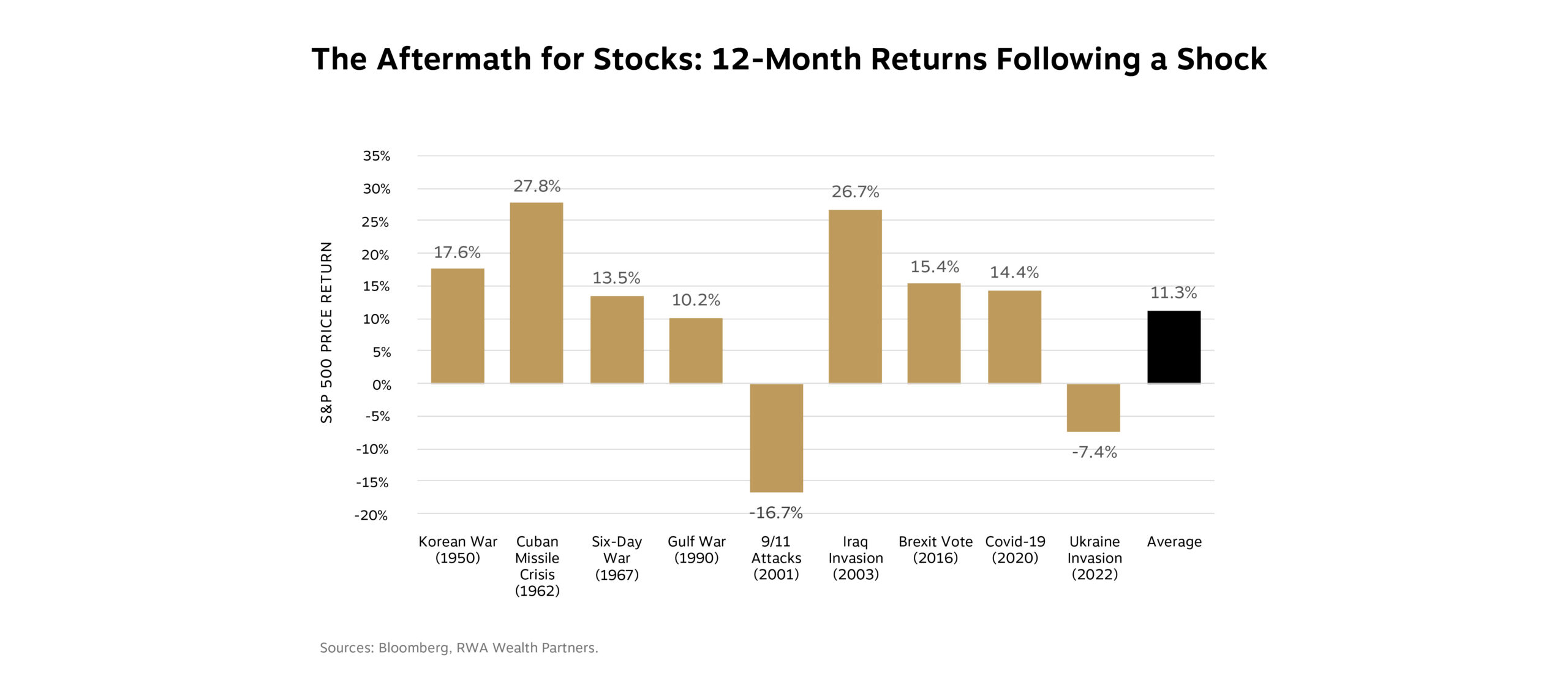
Chart showing 12-month S&P 500 returns following a market shock over the last 75 years.That pattern reflects what we often see in real time: Markets quickly reprice uncertainty, then return to fundamentals like growth, earnings, policy and liquidity. Even when geopolitical events were unsettling, history shows that many were ultimately manageable for long‑term investors as clarity improved.

A Calm, PlanningBased Response

Unease is a normal response to uncertainty. The goal of planning is not to ignore risk, but to prepare for how we’ll navigate it. Steps we can help you take right now include:

  • Maintaining adequate liquidity so spending needs don’t depend on forced selling
  • Using simple, documented rebalancing rules and if-then triggers to avoid emotion-driven decisions
  • Aligning portfolio risk with time horizon and goals so that volatility is tolerable

We’re not saying you should ignore the headlines—instead, our message is “let your plan set the course, not fear.”

Your RWA advisory team is monitoring developments and assessing risks to energy supply, inflation and policy. We’re making thoughtful adjustments where we believe they are warranted but not wholesale changes dictated by a single week of news.

We’ll keep you updated as conditions evolve. If you’d like to revisit your plan, spending approach or portfolio considering recent volatility, your RWA team is here to help.

Our Latest Media

In CIO JP Powers’ March Market Update, he gives his perspective on the economic and market outcomes of the ongoing conflict with Iran. He covers how stocks have fared across international markets and U.S. sectors and what’s happening in the bond market. He also reviews private credit as an asset class and puts a spotlight on some encouraging trends in the economy. Watch now.

In the latest episode of The Human Side of Wealth podcast, host Andrew Busa, director of private wealth financial planning, is joined by Senior Advisor and Partner Rick Winters and President of Private Wealth Steve Reder to explain why 2026 could be a pivotal year for proactive tax planning and how the One Big Beautiful Bill Act may impact you. Learn the difference between tax prep and tax planning, why many provisions are “permanent … until changed” and how to use today’s historically low rates to your advantage. Watch now to see how intentional, year-round planning may help you minimize taxes over a lifetime—not just in April.


Women and Wealth: Minding—and Bridging—the Gaps

Planning for Women

If you’ve ever ridden London’s Underground, you’ve heard announcements to “Mind the gap!” The messages call attention to the space between trains and platforms that creates a risk of stumbling or even slipping down to the tracks. They prompt you to take a confident step forward into the car and toward your destination.


For women investors, there are financial gaps, often subtle, to be mindful of that can stand between you and your long-term goals. High-achieving women managing careers, families, businesses and wealth face these headwinds from the checkout line to the boardroom. Some are as obvious as a divide on the ground, but others are hidden in the costs of day-to-day life.

Let’s look at six hurdles women may encounter and then discuss how your team at RWA and our Wealth With Intention initiative can help you plan for them.

Identifying the Gaps

  1. The pay gap. Despite meaningful progress over the decades, women working full time in 2024 earned 81 cents for every dollar earned by men—and the gap widened for the second consecutive year, the first time that’s happened in over 60 years. The disparity compounds with seniority: At the 90th income percentile (the top 10% of earners), women earn roughly $26,000 less per year than men at the same level. Over a 30-year career, the total pay gap more than doubles, with women’s earnings stalling in their mid-30s while men’s continue to grow well into their 40s.
  1. The pink tax. Women routinely pay more for comparable products and services—an average of 7% more across consumer categories and as much as 13% more for personal care products specifically. A J.P. Morgan analysis estimated the annual out-of-pocket cost at approximately $1,300. Over a lifetime, that adds up to a meaningful headwind on what’s available to save and invest.
  1. The investing confidence gap. Women invest less than men and start later, often due to lower earnings, higher caregiving burdens, less industry engagement and lower confidence—not because they are less capable or less interested. The consequences are significant. Women’s median retirement savings stand at $50,000, compared with $157,000 for men. Yet research consistently shows that when women do invest, they outperform their male counterparts: They trade less, diversify better and take a longer view.
  1. The advisory gap. Nearly 70% of U.S. women have never worked with a financial advisor, compared with 41% of men. Yet 77% of women say that access to a trusted advisor would meaningfully increase their confidence in managing wealth. RWA is addressing this lack of connection to advisors who understand and speak to women’s specific financial lives head-on through Wealth With Intention, our platform designed to engage, educate and empower women and rising generations.
  1. The life expectancy gap. Women in the U.S. live an average of 5.6 years longer than men—81.4 years versus 75.8, per the CDC’s most recent data. This means women need retirement savings that last longer and that can absorb higher costs related to living longer, such as health care expenses. A 2022 Bank of America/Merrill Lynch study estimates approximately 94% of women believe they will be solely responsible for their finances at some point in their lives.
  1. The capital gap. For women who own or are building businesses, the path to funding is steep. Companies founded solely by women received just 1% of U.S. venture capital in 2024. Early-stage funding—the kind that gets a business off the ground—has declined sharply, even as women-led companies have been shown to generate more revenue per dollar invested than their male-founded counterparts.

Bridging the Gaps

Acknowledging these gaps isn’t about lowering expectations. It’s about building a financial strategy that accounts for the actual terrain—and positions you to reach your goals in spite of it. Here’s how.

Start with a longer time horizon. Longevity planning isn’t optional for women. That means stress-testing retirement income projections over a longer period, ensuring Social Security claiming strategy maximizes lifetime benefits, and having a clear plan for health care and long-term care costs, which tend to fall disproportionately on women.

Close the investing gap with intention. Working with an advisor to build a personalized, diversified investment strategy can meaningfully close the savings gap over time. Investing consistently, even in modest amounts, can narrow the retirement savings disparity over the long term.

Account for the pay gap in your savings rate. If your income today reflects structural underpayment, focusing on improving your savings strategy could help bridge the gap. That may mean maximizing tax-advantaged contributions, building a more aggressive savings rate during peak earning years, or structuring compensation differently—particularly for business owners who have more flexibility in how they pay themselves.

Protect and plan for transitions. Women are more likely to experience income interruptions like caregiving to children or aging parents (or both), career pivots, divorce, or the death of a spouse. A comprehensive financial plan can help you manage these transitions with greater confidence. That potentially includes securing appropriate insurance coverage, creating an estate plan that reflects your wishes and building liquidity reserves that preserve flexibility.

For entrepreneurs: Treat your business as a powerful driver of your personal wealth. Women-owned businesses represent a significant opportunity to build equity and shape a future on your own terms—when your business and personal financial strategies are aligned. Treating your business as part of your financial plan creates greater control and stronger exit options, and it can ensure the value you’re building today translates into long-term wealth, flexibility and financial security.

Wealth With Intention

Women have always navigated a financial landscape that wasn’t built with them in mind. As a reminder, it wasn’t until 1974 that a woman in the U.S. could obtain a credit card without a male guarantor. While meaningful progress has been made in recent years, many of the structural dynamics that have impacted women’s financial lives remain very real today .

Our Wealth With Intention initiative recognizes these realities not as limitations, but as context that matters. If you’d like to talk about how your current strategy accounts for these dynamics or take extra steps to bridge the gaps, your RWA team is here to help.

Before the Great Wealth Transfer: How To Prepare

Readying for an Inheritance

A major change to the wealth landscape is gathering momentum: Somewhere between $80 trillion and $120 trillion is expected to change hands over the next two decades, making this the largest intergenerational transfer of wealth in history. And women will be at the center of it—as surviving spouses, as adult children and as the next stewards of family wealth built over a lifetime.


But here’s what the statistics don’t take into account: For most of us, inheriting wealth will feel like a loss, not an opportunity.

Whether it arrives through the death of a spouse or the passing of a parent, an inheritance almost always comes wrapped in grief. And yet certain obligations don’t pause for mourning—there are legal and administrative deadlines that require attention in the weeks following a loss. For people who were not the primary financial decision-maker in their household (typically women, but not always), the transition can be overwhelming.

The good news is that this moment doesn’t have to arrive without preparation. The years before a transfer occurs are the most valuable ones, and there is meaningful work that you can start now with the help of your team at RWA.

Build Confidence

Start with an honest assessment of where you stand. The data paints a clear picture of how many inheriting spouses arrive at this moment underprepared. Only 49% of women have opened their own investment account, compared with two-thirds of men. More than a third of women don’t have an estate plan in place. And 84% of women say they lack confidence in their ability to manage an inheritance or financial windfall—compared with 73% of men. Just 16% say they feel completely confident.

These gaps are not permanent. They close with time, education and deliberate involvement. You don’t need to become a financial expert. Instead, think of it as gaining enough fluency to ask the right questions, evaluate advice and make decisions that reflect your own values and goals—not just inherited ones. The first step sounds simple, but it can be hard to take without help: Start talking.

Start With a Conversation

The most important financial conversations are the ones people keep putting off. For a spouse who has been on the periphery of financial decisions, that means asking to be brought fully into the picture. For an adult child, it means sitting down with aging parents to understand what they might expect from you and to go over the broad outline of their estate plan. 

These conversations are not always easy, but they can make an enormous difference. If you’re not sure how to broach the subject, know that our advisors and portfolio managers have guided many families through exactly these situations. 

It helps to understand not just the mechanics of an estate plan—where documents are held, how assets are titled—but also the intentions behind it. What did the people who built this wealth want it to accomplish? What values shaped the decisions they made? Our video “Wealth and Wisdom” explores exactly this: how to transfer values alongside assets and why that dimension of a transfer matters as much as the financial one. The framework we lay out in “Why Family Capital Matters” is also worth exploring for families thinking through how to have effective multigenerational conversations.

Be Prepared

Even with preparation, receiving an inheritance is hard. Grief is not a planning state. One of the most useful things you can do in advance is decide, simply, that you will not make major financial decisions in the immediate aftermath of a loss. While there are some actions you must take in the days and weeks following a loss, many big-picture decisions can wait. Giving yourself permission to pause is itself a form of planning. Our “The Great Wealth Transfer: What It Means for Women and Families” podcast episode addresses this transition and is worth a listen before you need it.

Planning ahead can help ensure that when you are ready to engage, you’re not starting from zero. You know who to call, you understand enough to ask good questions, and you have enough confidence in your own judgment to steward wealth in a way that reflects what actually matters to you.

Steps You Can Take

  • Review your current financial picture: where accounts are held, how assets are titled and what your estate documents say.
  • If you’re in a couple, ask to attend the next advisor meeting—and keep attending.
  • If you’re an adult child, ask your parents who their advisors are and where key documents are kept.
  • Have at least one honest conversation with a spouse or parent about what they want their wealth to accomplish—and share what you want, too.
  • Take one concrete step toward financial education and build from there (your advisory team can give you recommendations on request).
  • Think through what you would want to do with inherited wealth: lifestyle goals, charitable priorities, family considerations and more.

The transfer is coming, and no amount of financial preparation changes how hard it is to lose someone you love. But acting beforehand means you won’t be navigating that loss and a financial crisis at the same time. Our role is to help make hard times a little easier. Let’s start the conversation.

The information set forth in this communication is presented by RWA Wealth Partners, LLC (“RWA”). The contents are for informational and educational purposes only and are not intended as investment, legal or tax advice. Please consult with your investment, legal or tax advisor concerning any specific questions you may have. Past results are not indicative of future performance. The historical return of markets generally and of individual asset classes or individual securities may not be an accurate predictor of future returns of those markets, asset classes or individual securities. RWA does not guarantee the accuracy and completeness of any sourced data in this communication.

Never miss an issue.

By providing your email address you consent to receive marketing content from RWA Wealth Partners, LLC.